
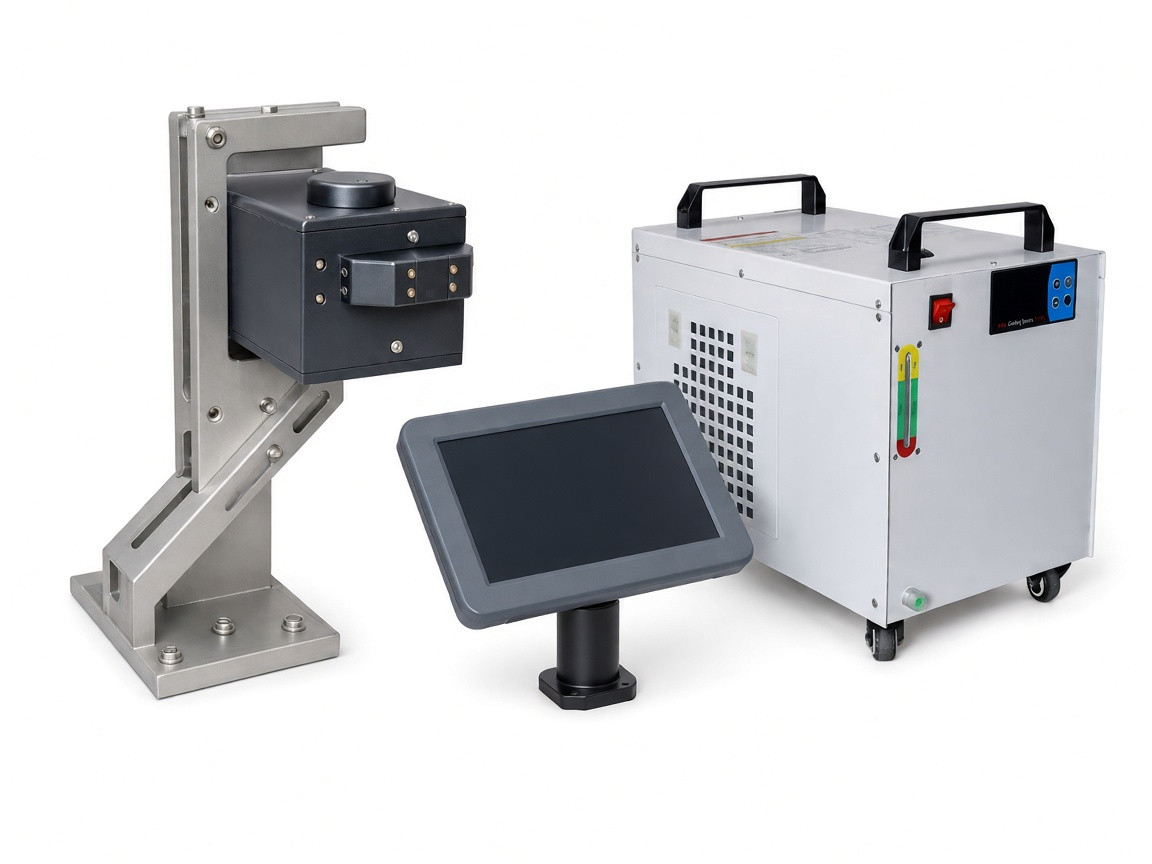
MARKTECH laser marking systems cover four flying or compact platforms and a handheld option. This note summarizes official material guidance and published model facts so distributors, OEMs, and plant engineers can choose a starting point. It is not a process window, an IP classification for every cabinet, or a substitute for a sample on the production material.
L1000 Series CO₂
The L1000 Series is a flying CO₂ marker for paper, film, plastics, wood, and other non-metals on medium- or high-speed packaging lines. Series literature also lists coated metal, organic glass, resin, bamboo and wood, and PVC among typical non-metal uses. The system does not use ink or solvent consumables. Models in the published L1040 family include L1040-10.6, L1040-10.2, and L1040-9.3.
L2000 Series fiber
The L2000 Series is an integrated fiber laser for most metals and some treated non-metals, including PVC, HDPE, foil, rubber, and plastics. Published models include L2020 and L2030. Fiber is the usual first look for permanent metallic part marks; coatings and filled plastics still need a sample.
L3000 Series UV and the 4005 compact UV
The L3000 Series is a water-cooled UV flying coder for pipes, plastic films, bottle caps, and similar PPR, PVC, and PE materials. Published models include L3030, L3050, and L3100.
The flagship 4005 Intelligent Compact UV Laser Marking Machine is a 5 W, 355 nm marker for high-speed continuous coding: marking speed up to 12,000 mm/s, line speed 0–300 m/min depending on material and content, a 70×70 mm field, water cooling, a 10-inch external Linux touchscreen, 23 kg mass, and a control box of 460×280×380 mm. Ingress protection is published as IP54 on the laser print head only — not as a cabinet-wide rating.
Q8A handheld laser
The Q8A handheld is a portable 1064 ± 5 nm fiber marker for oversized parts, rework stations, and hard-to-reach surfaces, where a fixed flying head is not practical. Official models are Q8A-20 (19.5 W), Q8A-30 (26.5 W), and Q8A-50 (50 W), with a 100 × 100 mm field, marking speed up to 10,000 mm/s, marking depth up to 1 mm depending on power and time, built-in air cooling, and 6–8 hours of operation on a 24 V lithium battery under normal use. Official marking-effect literature lists stainless steel, iron, aluminum, copper, electroplated or baked-paint surfaces, painted materials, hard plastics, and wood; confirm the process on a sample. The official control-software manual documents on-unit job editing (text, graphics, barcodes, and imported files), variable text including serial numbers, date, and time, red-light positioning and contour preview, continuous marking, and adjustable speed, power, and frequency.
How to use this note
Treat the material lists as official starting guidance, then confirm contrast, depth, and cycle time on the actual grade or coating. If you also need date or lot codes in ink on packaging, specify that job separately with CIJ, TIJ, or TTO. For integration signals used on laser cells, see the integration checklist.